"The tax rate is a seesaw," Worcester City Councilor George Russell told his colleagues during the city's tax classification hearing this past winter. He meant the annual fight over how much of Worcester's tax burden falls on homeowners versus businesses. But if you're shopping for a two- to four-unit property in Burncoat right now, that seesaw is doing something more specific to your numbers than you might realize, and it has nothing to do with the neighborhood you're looking in.
It has to do with the unit count.
The Line Nobody Prices Into the Listing
Ask any lender what separates a fourplex from a five-unit building and you'll get the same answer everywhere in the country, not just in Worcester. Properties with two to four units qualify for residential-style financing, the same FHA and conventional loan products a single-family buyer would use. Add a fifth unit and you cross into commercial multifamily lending: different underwriting, different rates, different down payment expectations, often a different lender entirely.
That line rarely shows up in a listing description. Nobody advertises "conventional financing eligible" the way they advertise a renovated kitchen. But it's doing more to shape what a property is worth, and who can afford to buy it, than almost any physical feature of the building.
In Worcester, that financing line runs parallel to something else: the city's own property tax structure.
Worcester's Rate Gap, in Dollars
Worcester runs a dual tax rate, meaning residential property and commercial property are taxed differently. For fiscal year 2026, the City Council set the residential rate at $13.28 per $1,000 of assessed value and the commercial rate at $29.06 per $1,000, more than double. Both rates ticked up from fiscal 2025, when residential sat at $13.19 and commercial at $28.61.
That gap isn't new, and it isn't shrinking. The Worcester Regional Chamber of Commerce has tracked it since the city adopted dual taxation in 1984, when commercial and industrial property covered 35 percent of the tax base. Today that share has fallen to 21 percent, with the difference shifted onto residential owners and, over time, contributing to businesses relocating to surrounding towns rather than staying in Worcester.
For a small multifamily owner, the practical question isn't the history. It's which side of that line your building falls on.
The council debate over this year's rates got heated enough that Councilor Jenny Pacillo pushed back on the framing entirely.
"It shouldn't be residents vs. commercial."
Councilor Khrystian King took a longer view, arguing that "a gradual movement toward a greater balance between commercial and residential certainly makes sense," while acknowledging the city still needs the revenue to fund core services. Both were talking about homeowners and businesses. Neither was talking about triple-deckers. But the same mechanism that sets those two rates is exactly what a multifamily buyer in Burncoat is underwriting against.
The Proposal That Could Move the Line
Here's where it gets specific to right now, not to real estate in general.
During that same rate-setting debate, Councilor Bergman said he plans to bring forward a proposal to reclassify residential buildings with nine or more units into the commercial tax category. His own estimate: roughly 1,000 properties citywide would shift, generating about $18 million in additional revenue for the city.
That proposal has not passed. It wasn't part of the rate package the council approved unanimously that December. But it's on the table, and it tells you something about the direction Worcester is leaning. If you're evaluating a nine-plus unit building anywhere in the city, you're not just underwriting today's tax bill. You're underwriting the possibility that your bill roughly doubles if this proposal, or something like it, moves forward in a future cycle.
If you're looking at a fourplex in Burncoat, that specific proposal doesn't touch you. It targets a much larger tier of building than the small multifamily stock that dominates this neighborhood. But it's a useful data point precisely because of what it reveals: the city is actively thinking about where to draw the line between "residential" and "commercial" treatment for rental property, and unit count is the lever it keeps reaching for.
Why Burncoat's Triple-Deckers Don't Flinch
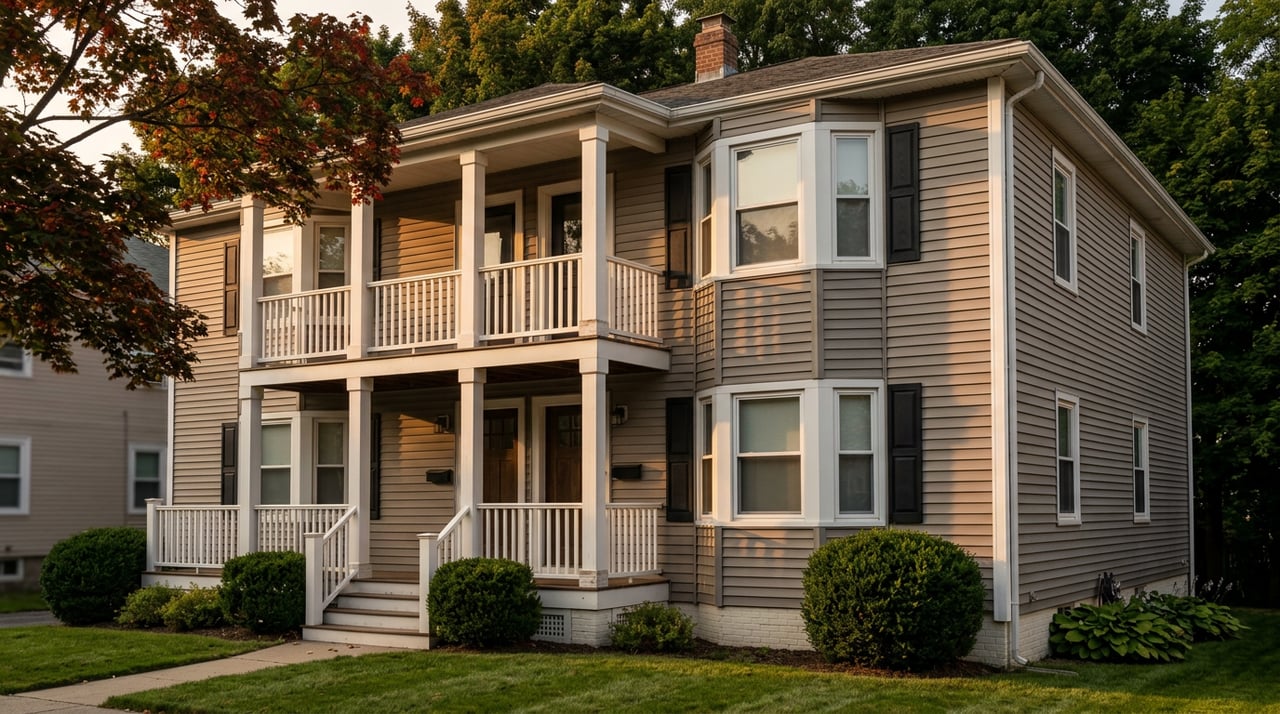
Burncoat's multifamily stock skews toward exactly the size that stays clear of both the financing cliff and the political one. Two-family and three-family homes here tend to rent to longer-term, family-oriented tenants rather than the higher-turnover, younger renter pool you'd find closer to the colleges or the Canal District. That stability shows up in how these properties trade. Buyers pay a bit more for the predictability of a tenant base that isn't turning over every August, and sellers who've held a well-maintained two- or three-family here for years are often sitting on more equity than they expected, precisely because that stability commands a premium rather than a discount.
The broader Burncoat market has stayed steady through this stretch too. The typical home in the neighborhood, across all property types, sold for $437,337 in April 2026, up a modest 0.6 percent from the year before. That's not a market swinging wildly in either direction. It's a market where a buyer can actually run the numbers on a specific building without guessing whether the comps will be stale in six months.
Put those two facts together and the shape of the opportunity gets clearer. A fourplex in Burncoat gets residential financing, sits comfortably under any reclassification threshold currently being discussed, and rents to tenants who tend to stay. A twelve-unit building anywhere in the city carries commercial financing terms today and a live risk of a higher tax rate tomorrow. Same asset class, same city, structurally different risk profile, and the difference has almost nothing to do with location and almost everything to do with the number of doors.
What This Means If You're Actually Underwriting a Deal
A few things worth doing before you write an offer on a Burncoat multifamily property, not after:
Confirm the current classification code with the city assessor's office rather than assuming it based on unit count alone. Worcester's assessing division maintains property records that show how a specific parcel is currently classified, and that record is the only one that actually matters when your tax bill arrives.
Run your financing pre-approval against the actual unit count of the property you're bidding on, not a similar one down the street. A three-family and a five-family can look nearly identical from the curb and require entirely different loan products.
If you're looking at anything approaching nine units, build a wider margin into your projections. The reclassification proposal is not law, and it may never pass in its current form. But a serious investor prices in the possibility of a rule change on a building sitting close to a line the city council is actively discussing, rather than betting the whole return on the rule staying exactly as it is.
And if you already own a two- to four-unit property in Burncoat, the current structure is working in your favor on two fronts at once: friendlier financing if you ever refinance or sell to another owner-occupant, and a tax rate that isn't the one currently under political pressure.
A Few Questions Worth Asking Directly
Does buying a five-unit building automatically move my financing into commercial territory? Yes. The five-unit line is standard across lenders, not a Worcester-specific rule. A four-unit purchase can typically use conventional or FHA financing. A five-unit purchase moves into commercial multifamily loan products, which usually means different rates, different terms, and a different approval process.
If I add a unit to my Burncoat fourplex, does that change how it's taxed? It could. Adding a unit changes how the assessor's office classifies and values the property, and that reclassification can trigger a different valuation approach even before any citywide policy change. Anyone considering converting extra space into an additional unit should talk to the assessor's office first, not after the work is done.
Has the nine-plus unit reclassification proposal actually passed? No. As of the most recent tax classification hearing, it was a plan a councilor said he intends to bring forward, not something the council voted on or adopted. It's worth tracking if you own or are considering a larger building in Worcester, but it isn't current policy.
If you're weighing a multifamily purchase in Burncoat, or wondering how a property you already own would classify under the current rules, Erin Zamarro can walk through the specific numbers with you. Get a free home valuation and find out exactly where your property sits before you make your next move.